Time Speed Distance Calculator (TSD)
Result will appear here Default example is loaded below.
Use our free Speed Distance Calculator to instantly find speed, distance, or time — just enter any two values and get the answer in one click. Powered by the core TSD formula D = S × T, this tool supports km/h and m/s with automatic unit conversion and delivers a full step-by-step solution so you understand every calculation, not just the result. Perfect for students, teachers, engineers, and everyday commuters across the world. Whether you're solving a physics or math problem, planning a road trip, calculating running or cycling pace, or working out flight travel time — this calculator handles it all. Supports kilometres, meters, miles, hours, minutes, and seconds automatically. No formulas to memorise, no sign-up required. Just fast, accurate answers with a clear breakdown every time. Try it free — works perfectly on mobile, tablet, and desktop worldwide.
Km/h to m/s Converter Trick (×5/18) — Fast Exam Method
Convert km/h to m/s in seconds using the student-friendly rule × 5 18 . Popular memory line: “Multiple of 5, Multiple of 18”.
18 km/h = 5 m/s — every +18 km/h adds +5 m/s.
Km/h to m/s Conversion Table — Easy Shortcut to Remember
| Km/h | m/s |
|---|---|
| 18 | 5 |
| 36 | 10 |
| 54 | 15 |
| 72 | 20 |
| 90 | 25 |
| 108 | 30 |
| 126 | 35 |
| 144 | 40 |
| 162 | 45 |
| 180 | 50 |
Memory Tip: Remember the base 18 km/h = 5 m/s. Then keep adding 18 → +5 to get the next answers.
Why do we multiply by 5 18 ? (Tap to read)
Because 1 km = 1000 m and 1 hour = 3600 seconds. So 1 km/h = 1000 3600 m/s = 5 18 m/s .
Note: This is a learning shortcut for calculations (useful for Physics and Time–Speed–Distance).
TSD Formula Quick Reference
The three core Time Speed Distance formulas cover every possible question type. Knowing which variable to solve for — and keeping units consistent — is 90% of the battle in competitive exams.
| Find | Formula | Example |
|---|---|---|
| Speed | S = D ÷ T | 120 km in 2 hr → 60 km/h |
| Distance | D = S × T | 60 km/h for 3 hr → 180 km |
| Time | T = D ÷ S | 90 km at 45 km/h → 2 hr |
Average Speed — The Most Misunderstood TSD Formula
When a vehicle travels equal distances at two different speeds, the average speed is NOT the arithmetic mean. It is the harmonic mean: Average Speed = 2 × S₁ × S₂ ÷ (S₁ + S₂).
Example: A car travels from city A to B at 40 km/h and returns at 60 km/h. Average speed = 2 × 40 × 60 ÷ (40 + 60) = 4800 ÷ 100 = 48 km/h, not 50 km/h. This distinction is tested in SSC CGL, CAT, and Bank PO every year.
Relative Speed — Trains and Moving Objects
When two objects move in the same direction, their relative speed = S₁ − S₂ (subtract). When moving towards each other, relative speed = S₁ + S₂ (add). This concept is the foundation of all train problems in competitive exams.
Example: Two trains of length 100 m and 150 m move towards each other at 60 km/h and 40 km/h. Relative speed = 100 km/h = 250/9 m/s. Time to cross = (100+150) ÷ (250/9) = 250 × 9/250 = 9 seconds.
Stoppage Time — A Railway Exam Favourite
Stoppage time measures how many minutes per hour a train stands still. Formula: Stoppage Time = ((S₁ − S₂) ÷ S₁) × 60, where S₁ = speed without stoppages, S₂ = speed with stoppages. If a train runs at 75 km/h without stops and 60 km/h with stops, it rests for ((75−60)÷75) × 60 = 12 minutes every hour. Try our dedicated Stoppage Time Calculator for instant answers.
Time Speed Distance Calculator FAQs
Below are some common questions related to time, speed, distance calculations and km/h to m/s conversion. These answers are based on standard formulas and logical unit conversion.
Why do we need to convert km/h to m/s?
Conversion is required because formulas work correctly only when units are consistent. Many physics and Time–Speed–Distance problems use meters and seconds as base units. Mixing km/h with seconds can lead to incorrect answers.
Why is the conversion factor 5/18 used?
The factor 5/18 comes from basic unit values. Since 1 kilometer = 1000 meters and 1 hour = 3600 seconds, converting km/h to m/s means multiplying by 1000 ÷ 3600 = 5/18.
Can I directly use km/h in Time–Speed–Distance formulas?
Yes, but only if all other units match. For example, km/h should be used with hours, not seconds. If time is given in seconds, speed must first be converted to m/s for accurate calculation.
Does this calculator show exact or rounded values?
This calculator is designed to show accurate values with proper unit conversion. Results are displayed clearly, and both units (like km and meters) are shown wherever applicable for better understanding.
Who can use this calculator?
This calculator can be used by students, teachers, and common people who want to calculate or understand time, speed, or distance in daily life, academics, or exam preparation.
Is this calculator suitable for competitive exams?
Yes, the logic and formulas used here are the same as those taught in school-level physics and competitive exam preparation. The conversion table and step-by-step explanation help in faster problem solving.
Note: This page is designed for learning and quick reference. Always use consistent units for accurate results.
Time Speed Distance Formula
The Time–Speed–Distance relationship is used in school math, physics basics, travel planning, and exam problems. Every TSD problem relies on one simple formula triangle.
D = S × TS = D ÷ TT = D ÷ S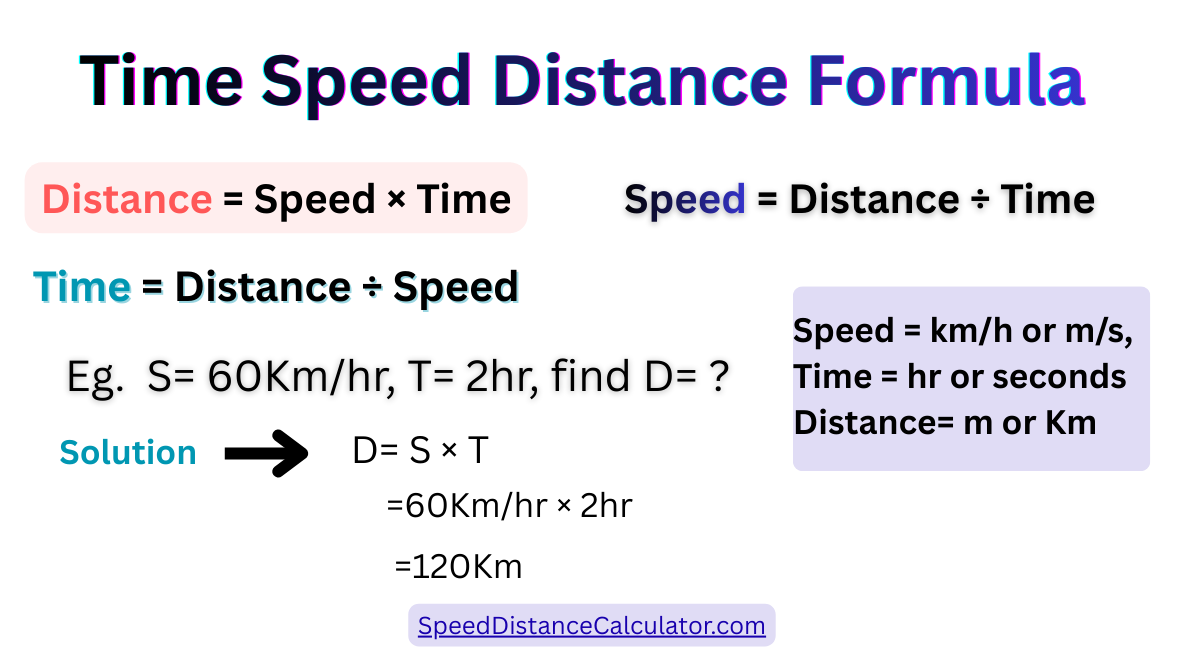
How to Calculate Speed Manually
Step 1: Choose what you want to calculate (Distance, Speed, or Time).
Step 2: Enter the other two values and select units.
Step 3: Click Calculate to get the final answer and steps.
Create your own ID Card through ID Card Generator free of cost.
Time Speed Distance Example Problems
Google ranks calculator pages higher when they include worked example problems. Practice these classic TSD scenarios covering all three formulas — distance, speed, and time.
Example 1 — Find Distance
A car travels at 80 km/h for 3 hours. How far does it travel?
Example 2 — Find Speed
A train covers 360 km in 4 hours. What is its speed?
Example 3 — Find Time
A cyclist travels 120 km at 20 km/h. How long does it take?
Example 4 — m/s Units
A ball rolls at 10 m/s for 30 seconds. What distance does it cover?
Solution: Distance = Speed × Time = 10 × 30 = 300 meters
Example 5 — Convert and Calculate
A bus moves at 72 km/h. Convert to m/s and find distance covered in 50 seconds.
Step 1 — Convert: 72 km/h × 5/18 = 20 m/s
Step 2 — Distance: D = 20 × 50 = 1000 meters
Example 6 — Average Speed
A person drives from A to B at 60 km/h and returns at 40 km/h. What is the average speed for the whole journey?
Solution: Average Speed = 2AB ÷ (A+B) = (2 × 60 × 40) ÷ (60 + 40) = 4800 ÷ 100 = 48 km/h
⚠ Do NOT use (60+40)÷2 = 50 km/h — that is a common exam mistake!
Speed Distance Time Table
This reference table helps you quickly look up distance values for common speed and time combinations — useful for exam preparation and daily travel planning.
| Speed | Time | Distance |
|---|---|---|
| 40 km/h | 1 hour | 40 km |
| 60 km/h | 2 hours | 120 km |
| 80 km/h | 3 hours | 240 km |
| 100 km/h | 4 hours | 400 km |
| 120 km/h | 2.5 hours | 300 km |
| 30 km/h | 90 min | 45 km |
| 5 m/s | 60 seconds | 300 m |
| 10 m/s | 120 seconds | 1200 m |
📌 Tip: Keep units consistent — use km/h with hours, and m/s with seconds for accurate results.
Applications of Speed Distance Time
TSD problems appear in many real-world situations. Understanding this formula helps in academics, competitive exams, and everyday life.
Calculate how long a road trip will take, or how far you can drive in a given time.
Airlines use TSD to schedule flights, calculate fuel, and estimate arrival times.
Runners and cyclists use TSD to track pace, set targets, and measure performance.
TSD questions are common in CAT, SSC, Bank PO, GRE, and other aptitude tests.
Exam Tricks for TSD Problems
These shortcuts can save you precious time in competitive exams where every second counts.
Average Speed Formula
For two equal distances at speeds A and B, average speed is 2AB ÷ (A+B) — NOT (A+B)÷2.
km/h ↔ m/s Conversion
Multiply km/h by 5/18 to get m/s. Multiply m/s by 18/5 to get km/h.
Relative Speed
Objects moving in the same direction: subtract speeds. Moving opposite: add speeds.
Common Mistakes in Time Speed Distance Problems
Even experienced students lose marks due to avoidable errors. Here are the most common TSD mistakes and how to avoid them:
Using (A+B)÷2 for Average Speed
For equal distances at two speeds, many students use simple average. This gives the wrong answer.
Mixing Units (km/h with seconds)
Applying D = S × T using km/h for speed and seconds for time gives a completely wrong distance.
Forgetting to Convert Units Before Calculating
Entering speed in km/h and time in minutes without conversion leads to incorrect results.
Confusing Relative Speed Direction
Adding speeds for same-direction objects and subtracting for opposite-direction — a very common exam trap.
Speed Distance Time Shortcut Tricks for Exams
Master these TSD shortcut tricks to solve problems in seconds during competitive exams like CAT, SSC, Bank PO, and GRE:
The 5/18 Rule
To convert km/h → m/s, multiply by 5/18. To convert back, multiply by 18/5.
Harmonic Mean for Average Speed
If equal distances are covered at speed A and B, average speed = 2AB ÷ (A+B). Never use (A+B)÷2.
Time = Distance ÷ Speed (T=D/S)
Cover the variable you want in the triangle: cover T to get D÷S, cover D to get S×T.
Relative Speed Shortcut
Two objects moving toward each other: add speeds. Same direction: subtract speeds.
Real Life Uses of Time Speed Distance Formula
The average speed formula and distance formula physics are not just textbook concepts — they apply everywhere in daily life:
Use the speed calculation formula to estimate how long your drive will take, or how fast you need to go to arrive on time.
Railway timetables use TSD to plan routes. You can use time speed distance questions logic to find the fastest route.
Athletes track pace using the distance formula physics: if you run 5 km in 25 minutes, your speed is 12 km/h.
Pilots use the TSD shortcut tricks to calculate fuel, flight time, and distance covered at cruising speed.
People Also Ask
Common questions people search for about time, speed, and distance:
How do you calculate speed?
Speed is calculated by dividing distance by time: Speed = Distance ÷ Time. For example, if a car travels 150 km in 3 hours, its speed is 150 ÷ 3 = 50 km/h.
What is the distance formula?
The distance formula is Distance = Speed × Time. It is the core equation of all TSD (Time Speed Distance) problems in physics and mathematics.
What is the average speed formula?
For two equal distances covered at different speeds A and B, use the harmonic mean: Average Speed = 2AB ÷ (A + B). Do not use (A+B)÷2 — that only works for equal time, not equal distance.
How do you convert km/h to m/s?
Multiply the km/h value by 5/18. This works because 1 km = 1000 m and 1 hour = 3600 seconds, so 1 km/h = 1000/3600 = 5/18 m/s. Example: 72 km/h × 5/18 = 20 m/s.
What is relative speed in TSD?
Relative speed is the speed of one object as observed from another. If two objects move in opposite directions, their relative speed is the sum of their speeds. If they move in the same direction, it is the difference.
What are TSD shortcut tricks for exams?
Key TSD shortcut tricks include: (1) Multiply km/h by 5/18 to get m/s. (2) Use 2AB÷(A+B) for average speed over equal distances. (3) For the formula triangle, cover the unknown variable to read off the correct formula.
Time Speed Distance FAQs
Everything you need to know about TSD formulas, unit conversions, and common exam problems.
What is the TSD formula?
The core formula is D = S × T (Distance = Speed × Time). Rearranging gives:
- S = D ÷ T — to find Speed
- T = D ÷ S — to find Time
Always ensure your units are consistent before applying the formula.
How do you calculate distance from speed and time?
Multiply speed by time: Distance = Speed × Time.
Example: A car travels at 60 km/h for 3 hours → Distance = 60 × 3 = 180 km.
How do you convert km/h to m/s?
Multiply the km/h value by 5/18: m/s = km/h × 5/18
This is because 1 km = 1000 m and 1 hour = 3600 seconds, so 1 km/h = 1000/3600 = 5/18 m/s.
Example: 72 km/h × 5/18 = 20 m/s
What is average speed and how is it calculated?
For equal distances at two different speeds A and B, use the harmonic mean:
Average Speed = 2AB ÷ (A + B)
⚠ Do NOT use (A+B)÷2 — that's a common mistake in exams!
Example: Going at 60 km/h and returning at 40 km/h → Avg = (2×60×40)÷(60+40) = 48 km/h
Can I use km/h directly in TSD formulas?
Yes, but only when all other units match. Use km/h with hours (and km), or m/s with seconds (and meters). Mixing units (e.g., km/h with seconds) gives wrong answers — always convert first.
Is this calculator useful for competitive exams?
Yes! The formulas and logic here match those taught in school-level physics and tested in CAT, SSC, Bank PO, GRE, and other aptitude exams. The step-by-step explanation helps you understand the logic — not just the answer.
What is relative speed?
Relative speed is the speed of one object as observed from another moving object.
- Same direction: Relative Speed = |Speed₁ − Speed₂|
- Opposite direction: Relative Speed = Speed₁ + Speed₂
Example: Two trains at 60 km/h and 40 km/h moving toward each other → Relative speed = 100 km/h
Does this calculator show exact or rounded values?
This calculator shows accurate values with proper unit conversion. Results are displayed in both primary and secondary units (e.g., km and meters) for full clarity. Fractions are shown exactly where possible.
Note: This page is designed for learning and quick reference. Always use consistent units for accurate results.

Related Calculators
Explore more free calculators to solve common math and physics problems: